
Everything you need to know about the apprentice path, the Tennessee LLP license, and the road to running your own plumbing route.
Quick answer
To become a plumber in Tennessee, you need to complete at least one year (2,000 hours) of plumbing experience as an apprentice or helper, pass the Tennessee Limited Licensed Plumber (LLP) trade exam, and pay the $75 license fee to the Tennessee Board for Licensing Contractors. The LLP allows you to work on residential and small commercial projects under $25,000. For larger projects, you’ll need a CMC-A contractor license, which requires three years of experience and a Business & Law exam. The whole path from apprentice to fully licensed plumber typically takes one to four years depending on which license you pursue.
In this guide
1. What does a plumber actually do?
2. Tennessee plumber license types explained
3. Step 1: Meet the basic requirements
4. Step 2: Get hands-on experience as an apprentice
5. Step 3: Pass the Tennessee LLP exam
6. Step 4: Apply for your license
7. How long does it take to become a plumber in TN?
8. How much do plumbers make in Tennessee?
10. Start your career with Crest Plumbing
If you’re considering a career in plumbing in Tennessee — whether you’re fresh out of high school in Cookeville, leaving a different trade in Crossville, or moving back home to Sparta from a job somewhere else — this guide walks through exactly what the path looks like. I’ve trained plumbers, hired plumbers, and worked alongside plumbers across the Upper Cumberland for years, and the questions I get from people thinking about getting into the trade are almost always the same: How long does it take? How much does it cost? What license do I actually need? And what does the work pay once I’m done?
Plumbing in Tennessee has one of the friendlier licensing paths in the United States. There’s no four-year mandatory apprenticeship, the state exam is straightforward, and you can be a fully licensed Limited Licensed Plumber in about a year if you put in the work. Compare that to electrical, HVAC, or general contracting, and plumbing is a faster runway to a career that pays real money.
Here’s the whole path, step by step, from your first day as an apprentice to running your own service truck.
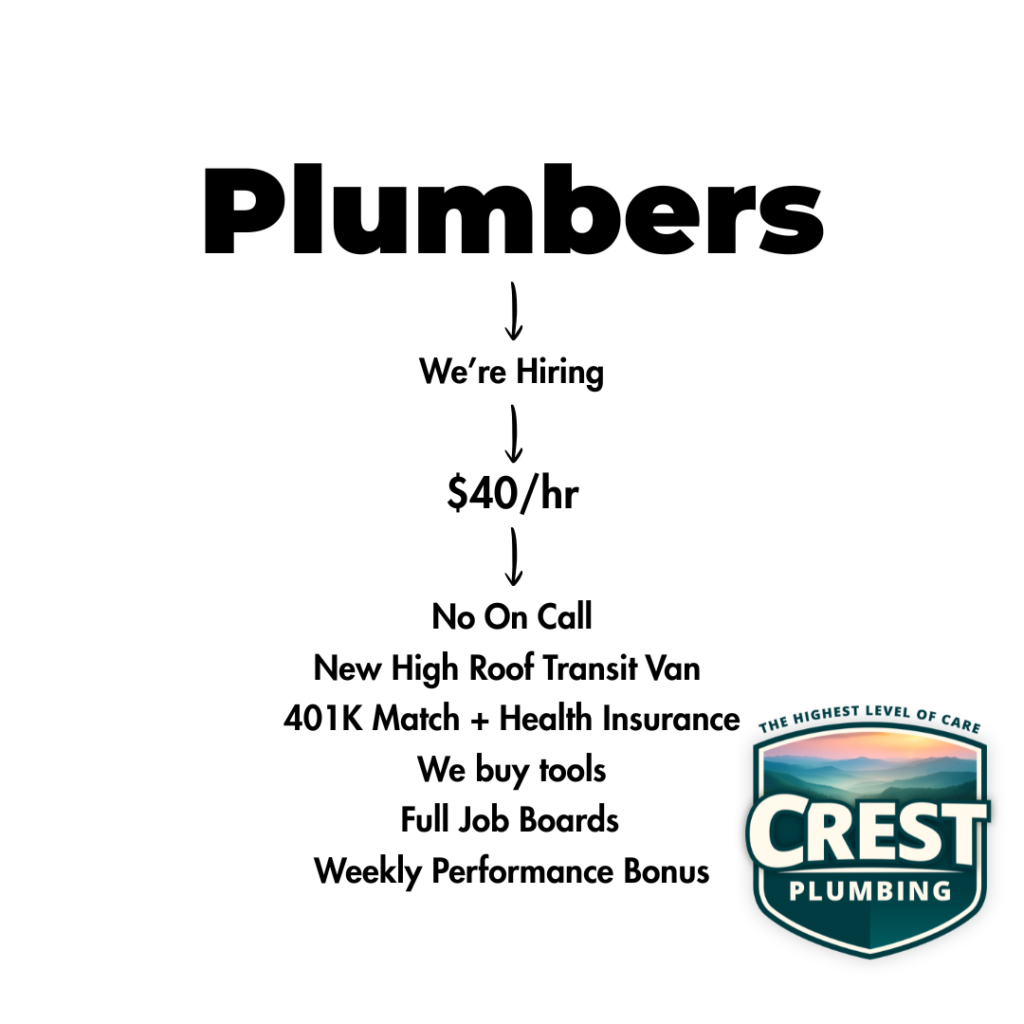
Looking for a plumbing apprenticeship in the Upper Cumberland?
Crest Plumbing is hiring in Cookeville, Crossville, and Sparta.
1. What does a plumber actually do?
A plumber in Tennessee installs, maintains, repairs, and inspects the systems that move water, gas, and waste through homes and small commercial buildings. The job covers more ground than most people realize: water heater installation and repair, drain cleaning, leak detection, pipe repair, sewer line work, gas line installation, fixture replacement, water filtration, and full plumbing inspections.
There are two broad categories of plumbing work to know about before you pick a path.
Residential service plumbers — what we do at Crest — work in homes diagnosing problems, explaining the fix to the homeowner, and doing the repair. The work is varied, customer-facing, and rewards plumbers who like solving problems and communicating well.
Commercial and new-construction plumbers work on larger projects — apartment buildings, office buildings, hospitals, new subdivisions. The work is faster-paced and more repetitive, and it usually requires the higher CMC-A contractor license rather than the LLP.

2. Tennessee plumber license types explained
Tennessee handles plumbing licenses differently than most states. There is no statewide “journeyman plumber” license like you’d find in Texas or Florida. Instead, the state offers two main credentials, and some larger cities issue their own local licenses on top.
Limited Licensed Plumber (LLP)
The LLP is the entry-level state plumbing license in Tennessee. It allows you to bid on and perform plumbing work on projects with a total cost under $25,000 — which covers nearly all residential service work. You’ll need one year of documented plumbing experience (2,000 hours), a passing score on the LLP trade exam, and a $75 application fee. The license is good for two years.
Contractor License with Plumbing Classification (CMC-A)
The CMC-A is the higher-tier license for plumbers who want to bid on projects $25,000 and above — new construction, larger commercial, multi-unit residential. It requires three years of documented experience, a Business and Law exam, a trade exam, a CPA-prepared financial statement, general liability insurance, and a $250 application fee. Most plumbers who want to start their own contracting company eventually get this credential.
Local journeyman or master licenses
A handful of Tennessee cities — Memphis, Chattanooga, and a few others — issue their own local plumbing licenses through municipal plumbing boards. If you plan to work in those areas, check with the local code enforcement office before applying for the state LLP. In the Upper Cumberland, including Cookeville, Crossville, Sparta, and most of Putnam, Cumberland, and White Counties, the state LLP is what you need.
Quick comparison: LLP vs. CMC-A
| Requirement | LLP | CMC-A |
|---|---|---|
| Experience | 1 year (2,000 hrs) | 3 years |
| Project limit | Under $25,000 | No limit |
| Exams | Trade only (44 Q) | Trade + Business & Law |
| Application fee | $75 (2 years) | $250 (2 years) |
| Financial statement | Not required | Required (CPA-prepared) |
3. Step 1: Meet the basic requirements
Before you can work toward a Tennessee plumbing license, you need to meet a few baseline requirements. These are the same whether you’re going for the LLP or working toward the CMC-A down the line.
- Be at least 18 years old.
- Have a high school diploma or GED.
- Be physically capable of the work — plumbing involves crawl spaces, lifting, ladders, and hot or cold environments.
- Have reliable transportation. Most apprenticeships expect you to get yourself to job sites.
- Pass a background check if you’re applying to a professional shop.
There’s no formal classroom requirement at the state level — Tennessee doesn’t mandate trade school before you can get licensed. That said, a technical college program at a place like the Tennessee College of Applied Technology (TCAT) in Cookeville or Crossville can shorten your learning curve and help you stand out in the apprentice job market.
4. Step 2: Get hands-on experience as an apprentice
This is the part of the path that matters most, and it’s also the part that most people get wrong. The Tennessee Board for Licensing Contractors requires you to document at least 2,000 hours (one year of full-time work) before you can sit for the LLP trade exam. Those hours have to be real — verifiable through pay stubs, an employer letter, or a notarized statement from a licensed plumber you worked under.
There are three common ways to get those 2,000 hours.
Apprenticeship at an established plumbing company
This is the path I recommend. Find a working residential or commercial plumbing company, take a job as an apprentice or helper, and work alongside a licensed plumber for a year. You learn the trade in real homes and on real job sites, you get paid while you’re learning, and the licensed plumber you work for can sign off on your hours when you’re ready to apply for the LLP. Crest Plumbing hires apprentices for exactly this path.
Trade school or technical college program
TCAT campuses across Tennessee offer plumbing technology programs that combine classroom instruction with practical training. Programs typically run 12 to 18 months and cost a fraction of a four-year degree. You’ll still need to pair the program with on-the-job experience to hit the 2,000-hour requirement, but the classroom side gives you a stronger foundation.
Registered apprenticeship program
Some Tennessee plumbing trade groups run formal four-year apprenticeship programs that combine paid work with night-school instruction. These take longer than the minimum LLP path, but they prepare you for the higher CMC-A contractor license and for master-plumber-level work.

5. Step 3: Pass the Tennessee LLP exam
Once you’ve documented your 2,000 hours of experience, you’re eligible to register for the Tennessee Limited Licensed Plumber exam. The exam is administered by PSI Services and costs $57 to sit for.
Here’s what to know about the test:
- Format: 44 multiple-choice questions, open-book.
- Time limit: 2 hours and 15 minutes.
- Passing score: 70%.
- Reference materials: You can bring approved code books and reference manuals into the exam, tabbed and highlighted. Most candidates use the International Plumbing Code and a Tennessee LLP exam prep guide.
- Topic areas: drainage and venting, water supply, fixtures and appliances, gas piping, code requirements, and basic safety.
Most apprentices who’ve worked a full year and reviewed the code book pass on the first attempt. If you’re nervous, six-hour exam prep seminars run regularly across Tennessee for around $200 to $300 — worth it if you’ve been out of a classroom for a while.
6. Step 4: Apply for your license
After you pass the exam, the final step is filing your LLP application with the Tennessee Board for Licensing Contractors. Submit:
- A completed LLP application form, signed before a notary.
- Proof of one year (2,000 hours) of plumbing experience — pay stubs, employer letter, or notarized verification.
- Your passing exam score from PSI.
- A $75 application fee, payable to “Contractor’s Board – LLP.”
- Proof of workers’ compensation insurance, or an exemption.
Mail everything to the Board at 500 James Robertson Parkway in Nashville. Processing typically takes one to two weeks. Once approved, you’ll receive a license number, and you can verify your active status anytime through the state’s online License Search tool.
Already a Tennessee LLP looking to switch shops?
Crest Plumbing is hiring licensed lead plumbers across the Upper Cumberland.
7. How long does it take to become a plumber in Tennessee?
The fastest path from “no experience” to “fully licensed Tennessee plumber” runs about 13 months: 12 months of documented apprentice work plus the few weeks needed to schedule the exam and submit your LLP application.
Most plumbers spend longer than the minimum because they want broader experience before they take the exam, or because they’re aiming at the higher CMC-A contractor license, which requires three years of documented experience. Here’s a typical timeline:
- Months 1–6: Apprentice work — riding with a licensed plumber, learning the trade, logging hours.
- Months 6–12: Increasing responsibility — running more complex jobs under supervision, studying for the LLP exam.
- Month 12–13: Sit for the LLP exam, file your license application, become a Limited Licensed Plumber.
- Years 1–3: Working as a licensed LLP — building experience, earning higher pay, becoming a lead service plumber.
- Year 3+: Eligible to test for the CMC-A contractor license if you want to bid larger projects or start your own company.
8. How much do plumbers make in Tennessee?
Plumber pay in Tennessee depends on license level, experience, and location. Based on current market data, here’s what plumbers across the state typically earn:
- Apprentice plumbers: $18 to $24 per hour ($37,000–$50,000 per year).
- Limited Licensed Plumbers (LLP): $35 to $46 per hour ($70,000–$92,000 per year).
- Lead service plumbers and master-level plumbers: $40 to $55+ per hour, with top earners over $115,000 annually with bonus and commission.
- Plumbing contractors (CMC-A) running their own shops: Highly variable — $80,000 to $250,000+ depending on the size of the operation.
In the Upper Cumberland — Cookeville, Crossville, Sparta, and the surrounding markets — the cost of living is lower than Nashville or Knoxville, which means a plumber earning $35 an hour here has more spending power than one earning the same in a metro area. More on plumber pay in Cookeville.
Plumbing is also one of the most recession-resistant trades. Pipes break, water heaters fail, and drains clog regardless of what the economy is doing. Across Tennessee and nationally, demand for skilled plumbers has consistently outpaced supply for the last decade, and that trend is expected to continue.
9. Frequently asked questions
Do you need a license to be a plumber in Tennessee?
Yes — to perform plumbing work as an independent tradesman in most Tennessee counties, you need either a Limited Licensed Plumber (LLP) credential or a CMC-A contractor license. Apprentices and lead service techs working under a licensed plumber don’t need their own license, which is why most people enter the trade as apprentices first.
How much does it cost to become a plumber in Tennessee?
The direct licensing costs are low — $57 for the LLP exam plus $75 for the two-year license, totaling $132. Add exam prep materials and an optional seminar and most candidates spend $300 to $500 out of pocket. If you choose to attend a TCAT plumbing program first, tuition runs roughly $4,000 to $6,000 over 12 to 18 months. The apprenticeship path costs essentially nothing because you’re earning a paycheck while you learn.
Can I get a plumber’s license in Tennessee without an apprenticeship?
Not really. The Tennessee Board for Licensing Contractors requires 2,000 hours of documented plumbing experience before you can sit for the LLP exam, and “documented” means verifiable from a licensed plumber or employer. Self-study or trade school alone doesn’t meet the requirement — you need real paid work in the field.
Is there a journeyman plumber license in Tennessee?
Tennessee does not issue a statewide journeyman plumber license. The closest equivalents are the Limited Licensed Plumber (LLP) for residential and small commercial work, and the CMC-A contractor license for projects above $25,000. A few cities like Memphis and Chattanooga do issue local journeyman licenses through municipal plumbing boards.
Does my Tennessee plumbing license work in other states?
Limited reciprocity. Tennessee has trade-exam waiver agreements with Alabama, Arkansas, Louisiana, Mississippi, and South Carolina for the CMC-A contractor license — but not for the LLP. If you plan to work in another state, you’ll generally need to apply for that state’s license separately.
Is plumbing a good career in Tennessee?
For people who like working with their hands, solving problems, and building a real skill — yes. The pay is solid, demand is steady, the licensing path is shorter than most other trades, and a licensed plumber in Tennessee can earn a comfortable middle-class income within a year or two of starting. The trade-off is that the work is physical, sometimes dirty, and occasionally unpleasant. If those aren’t dealbreakers, plumbing is one of the best career paths available in the state.
10. Start your plumbing career with Crest
Crest Plumbing is a residential plumbing company based in Cookeville, Tennessee, serving Cookeville, Crossville, Sparta, and the surrounding Upper Cumberland. We hire apprentices, licensed lead plumbers, and customer service representatives — and we treat training as a real investment, not a checkbox.
If you’re starting out and want to log apprentice hours toward your LLP, or you’re already licensed and looking for a shop that pays honestly and doesn’t pressure you to upsell, take a look at our open positions. Jeff reads every application personally.
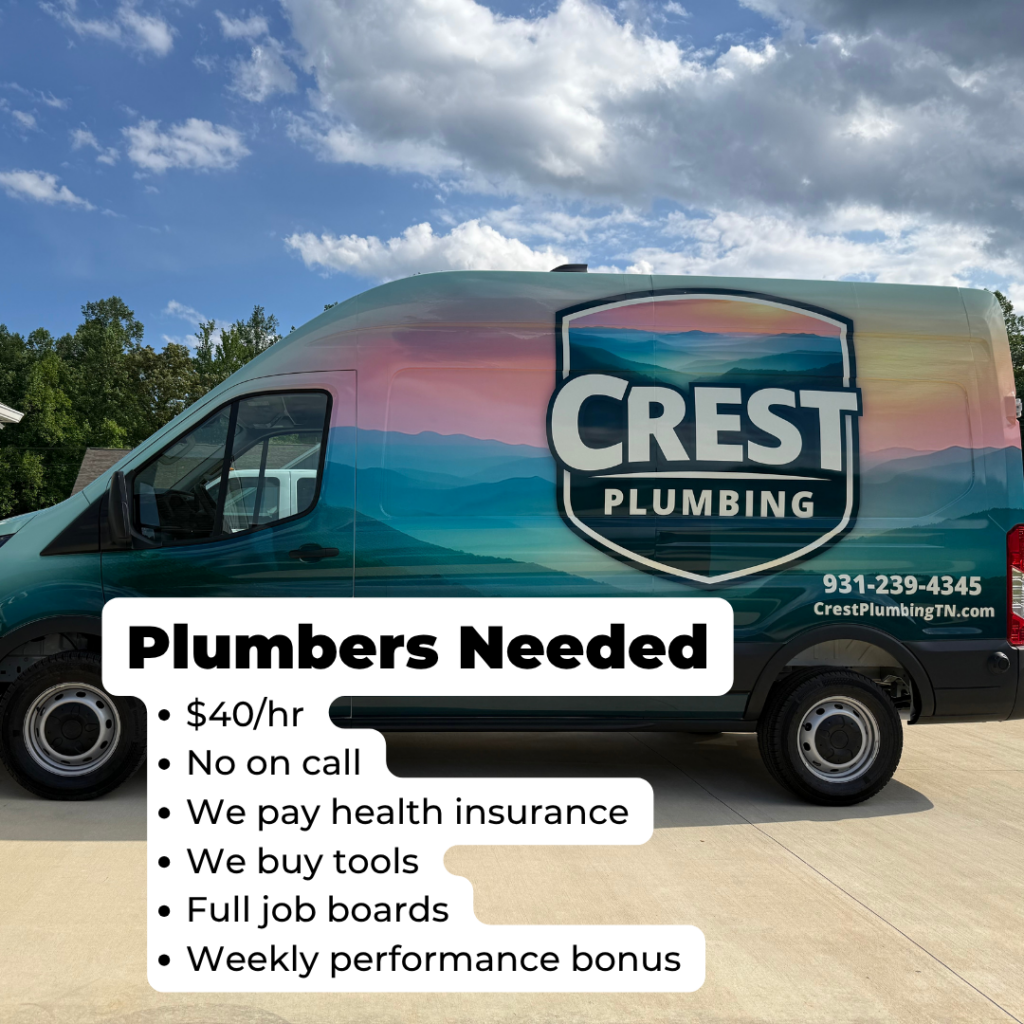
Ready to start your plumbing career in Tennessee?
Local routes · Honest pay · Real training · Apprentice through journeyman path
Call Jeff: (931) 239-4345
JR
About the author
Jeff is the owner of Crest Plumbing in Cookeville, Tennessee, a Limited Licensed Plumber, and a family man who is investing his time and money into making Cookeville a better place. Read more about Jeff.